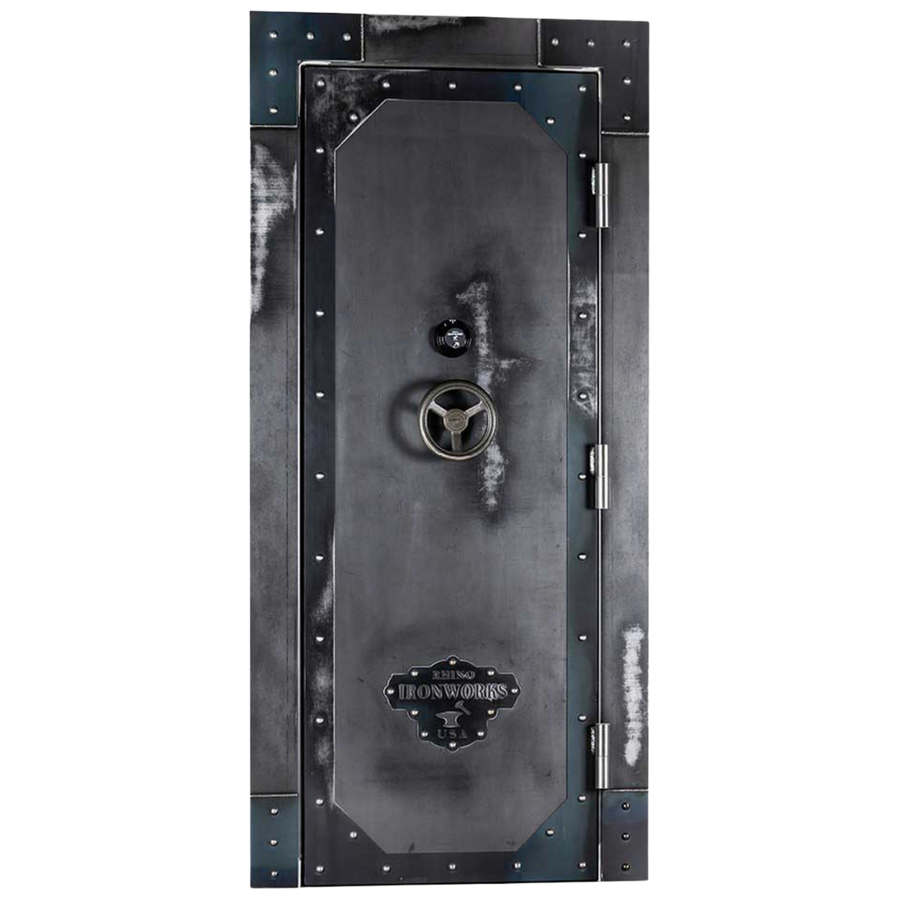
Rhino Metals - Vault Door Out-Swing (Ironworks) Series


Stocking ItemWe stock this — Quick Delivery

Your build

Key Features

Protection Level Enhanced Protection
Security Level 6
Fire Rating 120 min at 1400°F
Capacity Select a size to view
Weight Select a size to view
Made in USA Yes
Warranty Limited Life-Time
Rhino Metals | Vault Door Ironworks IWVD | Out-Swing

Rhino Metals - Vault Door Out-Swing (Ironworks) Series

Choose your configuration

Current Price  
The question worth answering before any specification is whether you need a room at all. A vault door makes sense when your collection has outgrown what containers hold, or when the house has a space better suited to a strongroom than a closet. This is the top of Rhino's door range. The honest condition is that the door is one wall of the room. The other three, plus the ceiling and floor, do as much work as the door does.

Who This Safe Is Best For — and When to Consider More

Choose this model if:

Choose a vault door when the answer to your storage problem is a room rather than another container. It fits when you have a space with interior walls that can be built or reinforced properly, and when you want to store things no safe will hold. Pick the out-swing door if your room layout can give up the floor space outside the opening rather than inside it.

Best For:

Your collection has passed the point where another safe solves it, and you have a space that could become a strongroom. You want to store things that will not fit in a container, and you are prepared for a build rather than a delivery. You want a room you can enter and stand in rather than a door you open and reach into.

Not Ideal For:

This is the wrong answer if a large safe would hold what you own, because a safe is simpler, cheaper and needs no construction. It is also wrong if the room you have in mind has exterior walls, a window, or framing that will not carry the load. If you need certified tool-attack resistance, no Rhino vault door carries a UL body rating.

What Makes the Vault Door Out-Swing (Ironworks) Different

You can specify a UL listed mechanical dial or a UL listed electronic keypad. A ball bearing drill plate protects the lock, and a spring-loaded relocker deadbolts the mechanism if the lock is attacked. A tempered glass relocker adds a second independent trigger: break the glass during an attack and a remote spring-loaded relocker fires. The patented anti-tamper clutched handle spins free under force rather than transmitting it to the boltwork.
The door is 5.38 inches thick with a quarter-inch steel face covering its full area, and the outer door frame is also quarter-inch steel. Full coverage matters here: a partial plate over a formed body is a different product, and the specification reads similarly on paper. The doorbolts run 1.25 inches in diameter with three-sided protection, 16 on the two narrower models and 17 on the two wider ones. Vault doors are the only Rhino products that use a bolt count at all, which is why this is the only place it appears.
The clamshell design closes the assembly around the rough opening rather than sitting inside it. That is what allows wall thicknesses from 6 to 12.5 inches. A concealment panel kit covers walls to the full 12.5 inches if you want the frame hidden. Standard and reverse opening are both available, so the swing can be specified to suit the room rather than forcing the room to suit the door. An internal release and panic room lock-in mechanism let you secure the room from inside.
Rhino Metals | Vault Door Ironworks IWVD | Out-Swing open view
The inside face is where a vault door differs most from a safe. An internal release lets you open the door from within the room without the lock, and the panic room lock-in mechanism lets you secure yourself inside deliberately. That combination is why a lot of these rooms end up serving two purposes. What the room holds is entirely up to how you build and fit it out, since the door imposes no interior configuration at all.
The Ironworks finish is applied by hand, so the antiqued surface differs door to door. Because a vault door is visible in a way a basement safe is not, finish choice carries more weight here than elsewhere in the line. The concealment panel kit is worth discussing early if you would rather the opening read as a wall than as a door. Weight runs from 907 to 1,137 pounds depending on width.

Security Construction & Burglary Protection

A vault door defends the one opening in a room that is meant to be opened. Doorbolts at 1.25 inches engage with three-sided protection. The walls, ceiling and floor around the door are not our product. A strong door in weak framing moves the problem rather than solving it. That is the first thing we look at on a site visit.

Highlight

A quarter-inch steel face across a 5.38 inch door, with 1.25 inch doorbolts and two independent relockers.
Learn More

Certified Fire Protection & What It Means

The 120-minute rating at 1400 degrees describes the door tested on its own, and Rhino states directly that real fire protection varies with installation and room construction. A dual intumescent seal expands as heat rises to close the gap between door and frame. What that rating cannot tell you is how the room performs, because a fire will attack the walls and ceiling as readily as the door. A vault room built with fire-rated assemblies behaves very differently from one framed in standard construction. We would rather set that expectation now than have you assume the door number describes the room.

Highlight

120 minutes at 1400 degrees with a dual intumescent seal, subject to how the surrounding room is built.
Learn More

Lock Type & Access Options

The lock is a UL listed mechanical dial or a UL listed electronic keypad, and either can be specified for standard or reverse opening. The internal release means anyone inside the room can get out without the lock, which matters in any space a person will actually enter. The panic room lock-in mechanism works the other way, letting you secure the room from inside deliberately. For households with children, an occupied strongroom needs both directions thought through before installation.

Highlight

Internal release, panic room lock-in, standard or reverse opening, and a concealment panel option to 12.5 inches.
Learn More

Interior Storage, Shelving & Organization

Living with a vault room is different from living with a safe, mostly in a good way. You walk in rather than reaching in, you can see everything at once, and shelving or racking is entirely your choice. The internal release means the room never feels like somewhere you could be trapped. Humidity is worth planning for at room scale rather than container scale, which usually means addressing the room's ventilation rather than dropping a dehumidifier inside. We talk this through during the build rather than after.
The inside face is where a vault door differs most from a safe. An internal release lets you open the door from within the room without the lock, and the panic room lock-in mechanism lets you secure yourself inside deliberately. That combination is why a lot of these rooms end up serving two purposes. What the room holds is entirely up to how you build and fit it out, since the door imposes no interior configuration at all.

Installation, Placement & Bolting Down

Installation planning often determines long-term satisfaction. A vault door sets into a rough opening, so the wall has to be right before the door arrives. We check doorway width and stair access on the route to the room during a site visit. Thickness runs 6 to 12.5 inches, and the header has to carry up to 1,137 pounds. Once the opening is ready we anchor the frame into the surrounding structure, which makes the door part of the wall rather than a panel hung in it.

One of the simplest ways to increase resistance is proper anchoring.

Highlight

We have installed more than 300 vault doors and we consult on room construction across our five-state service area.
Two workers guide a shrink-wrapped safe on a skid steer beside a house on a dirt lot

Is This Protection Level Enough for Your Situation?

This protects a room, not a box


The question worth answering before any specification is whether you need a room at all. A vault door makes sense when your collection has outgrown what containers hold, or when the house has a space better suited to a strongroom than a closet. This is the top of Rhino's door range. The honest condition is that the door is one wall of the room. The other three, plus the ceiling and floor, do as much work as the door does.
Step Up If:There is no higher vault door in the Rhino range, so a step up means a different construction approach rather than a different door. That usually means a purpose-built vault with certified wall assemblies, which is a project rather than a product. We consult on that kind of build, and it is a conversation worth having before framing goes up rather than after.
More Than Needed If:If a large safe would hold what you own, buy the safe. It costs less, needs no construction, and can be moved if you move. A vault door earns its place when the volume or the shape of what you are storing has genuinely outrun containers, and not before.

Rhino Metals Vault Door Out-Swing (Ironworks)

Technical Specifications

Models: IWVD8030 / IWVD8035 / IWVD8040 / IWVD8045

IWVD8030

Weight
907 lbs

IWVD8035

Weight
967 lbs

IWVD8040

Weight
1043 lbs

IWVD8045

Weight
1137 lbs

Frequently Asked Questions

Do I actually need a vault door, or would another safe do?
A vault door is the right answer when a room, not a container, is what you need. It protects everything the room holds, including items no safe will fit, and you walk in rather than reaching in. What we tell people is that if a large safe would hold it all, buy the safe instead.
How does a vault door compare to a safe door for thickness?
This door is 5.38 inches thick with a quarter-inch steel face across its full area, well beyond any gun safe door. The comparison matters less than it sounds, because a safe protects six sides and a door protects one opening. Full coverage is the phrase we tell buyers to check.
Does the 120-minute rating mean the room is protected for two hours?
That rating describes the door tested on its own. Rhino states directly that fire protection varies with installation and room construction, and a fire attacks walls and ceilings as readily as the door. This is where we see the most surprise: the room has to be built with fire-rated assemblies.
What is the real difference between a gun safe and a vault room?
Capacity and access. A vault room holds what no container will fit and lets you see everything at once. It can serve as shelter as well as storage. What we find is that at comparable spend the flagship safe is simpler, and the room wins only when volume has outgrown containers.
Is 120 minutes enough if wildfire is a concern?
For a structure fire it is a strong figure, but wildfire exposure can run far longer than two hours and the room's construction carries most of that difference. In the North Georgia foothills we plan differently than we do inside the perimeter. The door rating is the starting point of that conversation rather than the answer to it.

Ready to Secure What Matters Most?

Certified fire protection and UL-listed construction for balanced residential storage.

Compare Safes

See how this safe stacks up against similar models.